
El hombre y la máquina
Pintó el conflicto entre el hombre y la máquina cuando todavía era ciencia ficción.
El cuerpo humano frente al mecanismo y a las estructuras que desbordan al hombre.
Nacida en su estudio del barrio de Sarrià, en Barcelona, es la serie que lo ocupó el resto de su vida. No ilustra un tema de época: lo escribe desde dentro. La formación de ingeniero industrial está en cada engranaje, en cada sección, en cada despiece. Vicente Aguilera Cerni escribió sobre ella en 1974, en caliente, que «la máquina se ha convertido en algo invasor, en organismo irracional».
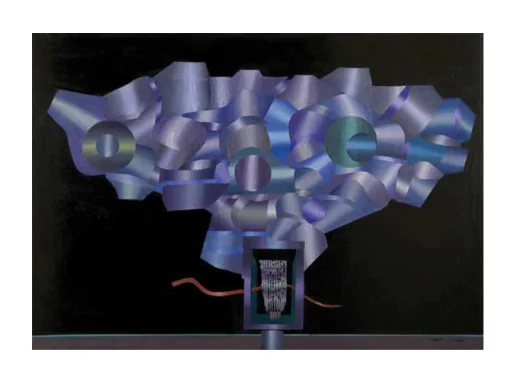
1976 · Óleo sobre tabla · 105 × 74 cm
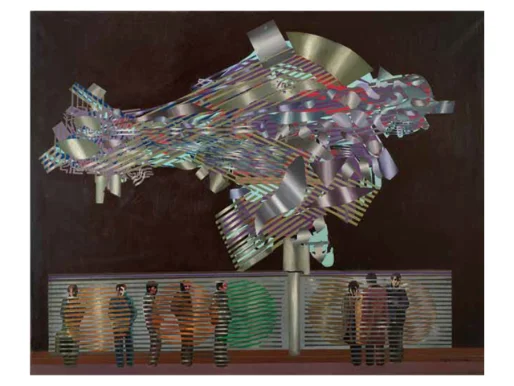
1976 · Óleo · 150 × 120 cm
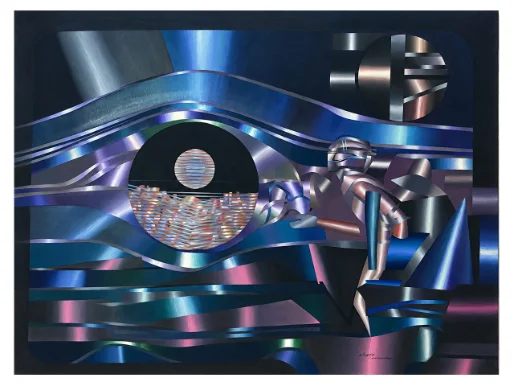
1978 · Óleo · 150 × 200 cm
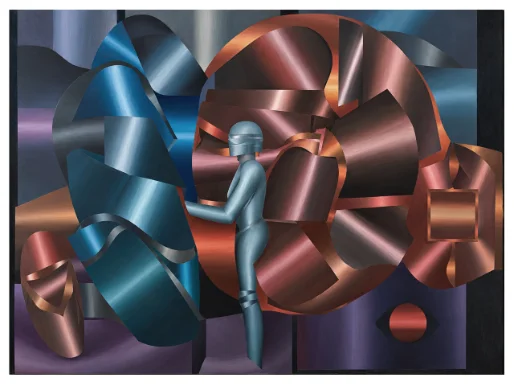
1976 · Óleo · 150 × 200 cm
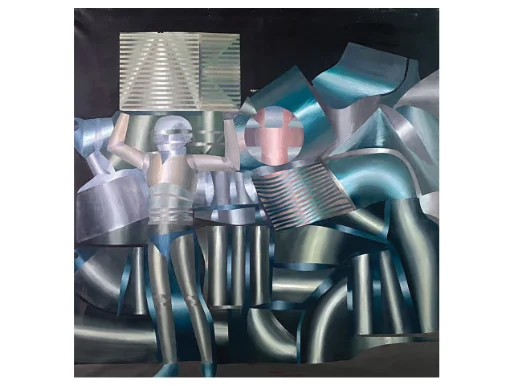
1977 · Óleo · 150 × 150 cm
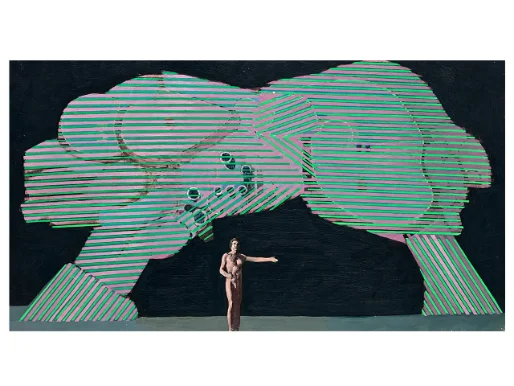
1972 · Óleo · 74 × 130 cm
Para acceder a una selección más amplia de obras de esta serie, contacte con nosotros.
«El aislamiento de las criaturas humanas, la anulación de la individualidad, el imperio desolador de la «muchedumbre solitaria», conviven con separaciones laberínticas y extrañas construcciones mecánicas que crecen como si estuvieran dotadas de anómala y amenazadora autonomía.»
Vicente Aguilera Cerni. Barcelona, 1974
Texto crítico
Alegre Cremades: el hombre y la máquina
Vicente Aguilera Cerni. Barcelona, 1974
El tema de la situación humana en la civilización maquinista constituye un eje fundamental en la obra de Antonio Alegre Cremades. Esto quiere decir que, al elegir uno de los grandes motivos de las tensiones y rupturas contemporáneas, ha renunciado voluntariamente a las ventajas que suministran a la imaginación artística la subjetividad y la arbitrariedad. Entonces, el mundo donde se desarrolla su inventiva es, a la vez, objetivación y creatividad. Pero la suya no es la construcción o la visualización de un orbe fantástico, sino la elaboración de una simbología directamente conectada con situaciones reales, o lógicamente previsibles.
Se ha denunciado incontables veces que las consecuencias de la máquina llevan hacia la cuantificación y la abstractificación de lo humano. Es decir: hacia lo numérico y lo carente del valor de humanidad. El diagnóstico es evidente. Sin embargo, las verdades sociales solamente se imponen cuando llegan a ser formuladas desde los más diversos campos de la cultura.
Lo que hace Alegre Cremades consiste, precisamente, en eso: en conferir a una idea su traducción visual, dando a la realidad objetiva las formas aportadas por la invención. De ese modo, el aislamiento de las criaturas humanas, la anulación de la individualidad, el imperio desolador de la «muchedumbre solitaria», conviven con separaciones laberínticas y extrañas construcciones mecánicas que crecen como si estuvieran dotadas de anómala y amenazadora autonomía. La máquina se ha convertido en algo invasor, en organismo irracional. Podemos decir que ésta es la versión estética de una alianza entre la sensibilidad sociológica y las previsiones de la ciencia-ficción.
Lo real se une con lo imaginario. Y lo imaginado se convierte en imagen configurada, elaborada y sometida a la voluntad creadora del artista. El concepto, el aviso y la señal de alarma han encontrado su fórmula comunicativa en el terreno de la cultura visiva. Igualmente, han hallado un procedimiento idóneo.
No se resuelve nada, pero el papel del arte en los conflictos de nuestro tiempo no puede ser resolutivo. Su única posibilidad reside en establecer sistemas de imágenes capaces de abrir las puertas de la conciencia dentro del microcosmos que las sociedades actuales y la cultura de masas consienten a los valores artísticos. Si a eso unimos la eficaz maestría de la realización, tendremos plenamente justificadas y enaltecidas las obras de Alegre Cremades.
Vicente Aguilera Cerni (Valencia, 1920–2005) fue presidente de la Asociación Española de Crítica de Arte y del Consell Valencià de Cultura, y Premio Internacional de la Crítica en la XXIX Bienal de Venecia (1959). El Museu d'Art Contemporani de Vilafamés, que conserva obra de Alegre Cremades, lleva su nombre. Texto recogido en el tomo III de Textos, pretextos y notas, Ayuntamiento de Valencia, 1987.
The Man and the Machine
He painted the conflict between man and machine while it was still science fiction.
The human body set against the mechanism, and against structures that overwhelm it.
Born in his studio in the Sarrià district of Barcelona, this is the series that occupied him for the rest of his life. It does not illustrate a theme of its time: it writes it from the inside. His training as an industrial engineer is in every gear, every section, every exploded view. Vicente Aguilera Cerni wrote of it in 1974, as it was being made, that «the machine has become something invasive, an irrational organism».
1976 · Oil on panel · 105 × 74 cm
1976 · Oil · 150 × 120 cm
1978 · Oil · 150 × 200 cm
1976 · Oil · 150 × 200 cm
1977 · Oil · 150 × 150 cm
1972 · Oil · 74 × 130 cm
For access to a wider selection of works from this series, contact us.
«The isolation of human creatures, the annulment of individuality, the desolating rule of the «lonely crowd», coexist with labyrinthine partitions and strange mechanical constructions that grow as though endowed with an anomalous and threatening autonomy.»
Vicente Aguilera Cerni. Barcelona, 1974
Critical text
Alegre Cremades: the man and the machine
Vicente Aguilera Cerni. Barcelona, 1974
The theme of the human condition within machine civilisation is a fundamental axis of Antonio Alegre Cremades’s work. This means that, in choosing one of the great motifs of contemporary tension and rupture, he has voluntarily renounced the advantages that subjectivity and arbitrariness afford the artistic imagination. The world in which his inventive power unfolds is, then, at once objectification and creativity. Yet his is not the construction or visualisation of a fantastical sphere, but the elaboration of a symbology directly connected to real, or logically foreseeable, situations.
It has been denounced countless times that the consequences of the machine lead towards the quantification and abstraction of the human — that is, towards the numerical and towards what is devoid of human value. The diagnosis is evident. Social truths, however, only take hold once they have been formulated from the most varied fields of culture.
What Alegre Cremades does is precisely that: to give an idea its visual translation, lending objective reality the forms supplied by invention. In this way the isolation of human creatures, the annulment of individuality, the desolating rule of the «lonely crowd», coexist with labyrinthine partitions and strange mechanical constructions that grow as though endowed with an anomalous and threatening autonomy. The machine has become something invasive, an irrational organism. We may say that this is the aesthetic version of an alliance between sociological sensibility and the forecasts of science fiction.
The real joins with the imaginary. And the imagined becomes a configured image, elaborated and subjected to the creative will of the artist. The concept, the warning and the alarm signal have found their communicative formula in the field of visual culture. They have likewise found a fitting procedure.
Nothing is resolved, but the role of art in the conflicts of our time cannot be resolutive. Its only possibility lies in establishing systems of images capable of opening the doors of consciousness within the microcosm that present-day societies and mass culture concede to artistic values. If to that we add the effective mastery of execution, the works of Alegre Cremades stand fully justified and exalted.
Vicente Aguilera Cerni (Valencia, 1920–2005) was president of the Spanish Association of Art Critics and of the Consell Valencià de Cultura, and winner of the International Critics' Prize at the XXIX Venice Biennale (1959). The Museum of Contemporary Art of Vilafamés, which holds work by Alegre Cremades, bears his name. Text collected in volume III of Textos, pretextos y notas, Valencia City Council, 1987. Translated from the Spanish.